What's the Difference Between a Hawker Centre and a Food Court?
Both look similar from the escalator: rows of stalls, plastic trays, a wall of laminated menus. But a plate of char kway teow from a hawker centre and the same dish from a mall food court come from two different systems, and the price tag usually gives it away first.
Visitors use the two terms interchangeably within their first day in Singapore, and locals almost never do. The distinction is not just semantics, it changes what you are eating, who runs the place, and even what cultural status the food carries. Once you know what to look for, telling the two apart from the escalator becomes almost automatic, and it changes how you plan a meal around Singapore's heat, budget or a specific dish you are chasing.
What's the actual difference between a hawker centre and a food court?
Hawker centres are open-air or semi-open public facilities built and managed by government agencies, mainly NEA or HDB-linked town councils, housing independent stall operators at subsidised rents, while food courts are private, usually air-conditioned operations inside malls, run by commercial chains that lease space to concessions. The two grew up serving related but different purposes: hawker centres consolidated street hawking into permanent, hygienic sites starting in the 1970s and 80s, while food courts followed later as a mall-based, climate-controlled alternative aimed partly at shoppers who wanted the same variety without the heat.
| Feature | Hawker Centre | Food Court |
|---|---|---|
| Setting | Open-air or semi-open-air, standalone building | Indoor, air-conditioned, inside a mall or complex |
| Run by | NEA or HDB town councils (public) | Private operators, e.g. Koufu, Food Republic, Kopitiam |
| Stalls | Independent hawkers, often family-run for decades | Concessions leased from the mall operator |
| Price | Generally lower, subsidised rents | Generally higher, commercial mall rents |
| Seating | Communal shared tables, tray return points | Communal seating, climate-controlled |
| UNESCO status | Part of hawker culture, inscribed 2020 | Not part of the UNESCO listing |
Who actually runs each one?
Hawker centres are formulated, licensed and administered under NEA's hawker management framework, or by HDB town councils where the centre is HDB-owned, while food courts are commercial operations run by private chains that lease stall space to individual concessions. That ownership split explains most of the other differences on this page. A hawker stall operator typically holds a licence directly from the managing agency and often runs the same stall personally for years or decades, while a food court stall is more likely to be one outlet of a chain, staffed by employees rather than the owner. NEA's own overview of how it manages hawker centres lays out the licensing and policy side in more detail.
Why do hawker centres tend to be cheaper?
The subsidised rent structure is the core reason. Government-built hawker centres keep stall rents deliberately low to preserve affordable food access, and that lower cost base flows through to menu prices in a way a mall's commercial lease rates cannot match. It is not that food court cooking is worse, it is that the underlying real estate economics are built for two different goals, one prioritising affordability and the other prioritising a climate-controlled retail environment. A food court operator also has to price in things a hawker stall rarely carries directly, mall common-area charges, centralised air conditioning, and a management layer between the stall and the landlord, and all of that shows up on the till receipt eventually.
Is the food variety actually different between the two?
Hawker centres generally pack in more independent stalls and a wider spread of drink specialists, while food courts tend to run fewer, larger stalls and often just one or two drink counters operated by the mall tenant itself. That difference shows up most clearly at the drinks corner: a hawker centre might have three or four separate stalls each with their own recipe for teh tarik, barley water or sugarcane juice, while a food court usually consolidates all drinks into a single counter run by the operator. It also shows up in recognition: the world's first Michelin star awarded to a street food stall went to a hawker stall inside Chinatown Complex, and Michelin's Bib Gourmand list for Singapore, covered in our guide to Michelin Bib Gourmand hawker food, is built almost entirely from hawker centre stalls rather than food court concessions.
Does it actually matter for a visitor which one you pick?
For food quality alone, not always, both formats can serve excellent dishes, but hawker centres carry the cultural weight food courts do not, since Singapore's hawker culture was inscribed on UNESCO's Representative List of the Intangible Cultural Heritage of Humanity in 2020. That inscription, recognised by UNESCO, applies to hawker centres specifically, not to mall food courts. Our practical advice: eat at least one real meal at a hawker centre for the actual cultural experience, such as Maxwell Food Centre or any of the stops in our guide to the best hawker centres in Singapore, and treat food courts as a comfortable, air-conditioned backup on a hot or rainy afternoon rather than the main event.
Is there a hawker centre that feels like a bit of both?
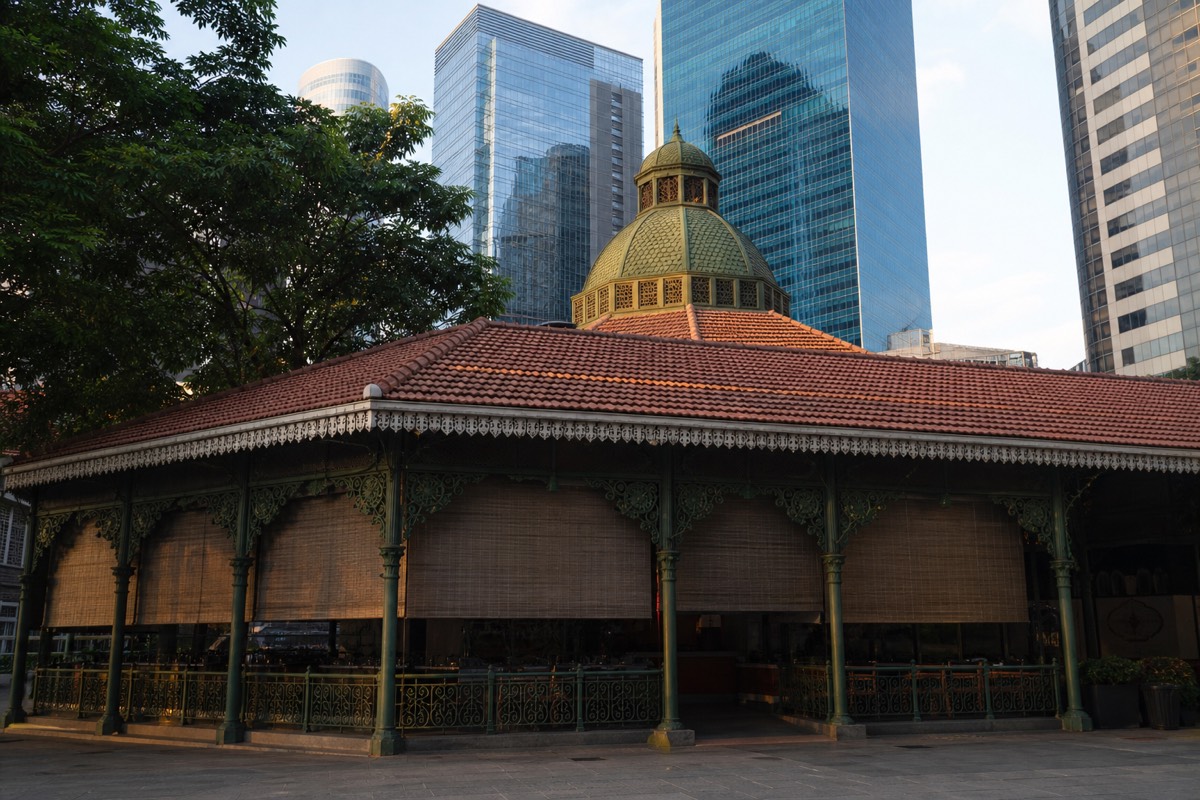
Lau Pa Sat comes closest. It is a genuine hawker centre inside a restored Victorian-era cast-iron market building, partially covered and noticeably cooler than a fully open-air site, with its own evening satay street closed off to traffic outside. It is still government-managed, independently run stalls, subsidised in the way hawker centres are, just with a roof and a more comfortable feel than the average open-air site. If the choice ever comes down to comfort during a rainy afternoon versus the full open-air atmosphere, a covered hawker centre like Lau Pa Sat is often the practical middle ground rather than defaulting straight to an air-conditioned mall food court.